
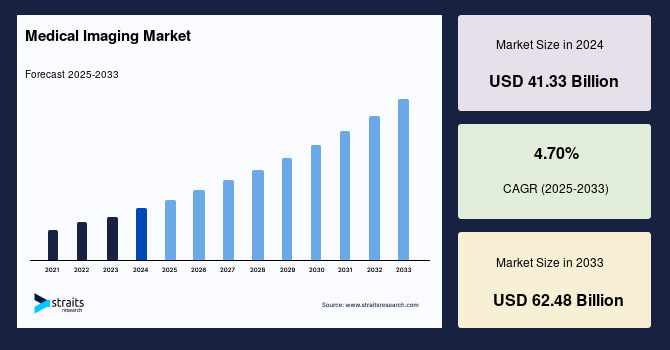
The global medical imaging market size was valued at USD 41.33 billion in 2024 and is projected to reach from USD 43.27 billion in 2025 to USD 62.48 billion by 2033, growing with a CAGR of 4.70% during the forecast period (2025–2033)
1. Introduction & Market Overview
Medical imaging refers to technologies used to visualize the interior of the body for clinical analysis and medical intervention. Common modalities include X-Ray, Ultrasound, Computed Tomography (CT), Magnetic Resonance Imaging (MRI), and Positron Emission Tomography (PET). These tools are critical for diagnosing conditions such as cancer, cardiovascular diseases, neurological disorders, and trauma. Hospitals traditionally dominate the medical imaging market, but adoption in outpatient clinics, diagnostic centers, and point-of-care settings is rapidly increasing.
The market’s growth is underpinned by aging populations, investment in healthcare infrastructure in emerging economies, growing screening programs, and advancements in imaging modalities that improve accuracy and workflow efficiency.
Get more information on : https://straitsresearch.com/report/medical-imaging-market
2. Latest Trends in the Medical Imaging Market
a. AI-Enabled Imaging Solutions
Artificial Intelligence (AI) is reshaping medical imaging by improving image interpretation, workflow automation, and diagnostic accuracy. AI tools are expected to support a significant portion of imaging workflows in the coming years, with enterprise and cloud-based AI adoption on the rise.
b. Portable & Point-of-Care Devices
Portable imaging systems, such as mobile CT scanners and handheld ultrasound units, are expanding access to imaging in emergency, remote, and underserved settings. These advancements support rapid diagnosis without the need for traditional imaging suites.
c. Cloud PACS and Integrated Workflow
Cloud-based Picture Archiving and Communication Systems (PACS) and enterprise imaging platforms streamline image storage, retrieval, and sharing across care settings. This model enhances collaboration, reduces latency, and enables centralized protocol management.
d. AI Confidence & Foundation Models
Beyond routine automation, large foundation models and deep learning are enabling cross-modality analysis and predictive diagnostics, particularly in oncology, neurology, and cardiology.
Download Sample Report Now : https://straitsresearch.com/report/medical-imaging-market/request-sample
3. Challenges & Opportunities
Key Challenges
Workforce Shortages: Radiologist and technologist scarcity is a global challenge, prompting adoption of automated solutions to maintain throughput.
High Equipment Costs: Advanced imaging modalities like MRI and PET systems entail significant capital outlay, limiting uptake in smaller facilities and developing countries.
Cybersecurity & Interoperability: Secure integration of imaging networks and interoperability with Electronic Health Records (EHR) are ongoing concerns.
Growth Opportunities
Emerging Markets: Asia-Pacific and the Middle East are witnessing rapid healthcare infrastructure investment, driving first-time imaging installations.
AI & Cloud Innovation: AI-driven diagnostics and cloud imaging workflows open avenues for recurring revenue and scalable solutions.
Chronic Disease Screening: Expanded cancer, cardiac, and neurological screening initiatives increase imaging demand.
Teleradiology & Remote Care: As telehealth grows, teleradiology services are emerging as a key growth pathway, enabling imaging interpretation irrespective of location.
Buy Now : https://straitsresearch.com/buy-now/medical-imaging-market
4. Segment Overview — ABC
A. By Product / Modality
X-Ray Systems: Widely used in general diagnostics, trauma, and orthopedics.
Ultrasound: Popular for obstetric, cardiac, and point-of-care imaging.
Computed Tomography (CT): Offers cross-sectional imaging with high clinical value and increasing adoption of AI enhancements.
Magnetic Resonance Imaging (MRI): High-resolution imaging used in neurology and musculoskeletal diagnostics.
Nuclear Imaging (PET/SPECT): Key in oncology and metabolic imaging.
B. By End-User
Hospitals: Largest segment due to comprehensive clinical services and high imaging utilization.
Diagnostic Imaging Centers: Growing rapidly due to outpatient care expansion.
Outpatient Clinics & Ambulatory Settings: Supported by portable and point-of-care imaging adoption.
C. By Geography
North America: Leading regional share driven by technological adoption and reimbursement frameworks.
Europe: Strong growth due to public health screening programs.
Asia-Pacific: Fastest growth, supported by healthcare modernization and infrastructure investment.
Rest of World: Emerging markets gaining ground through privatized healthcare expansion.
5. Top Players & Recent Developments (2024–2025)
Leading players in the medical imaging market include GE HealthCare, Siemens Healthineers, Philips Healthcare, Canon Medical Systems, Fujifilm, Hitachi Medical Systems, Hologic, Mindray, and Samsung Medison.
Recent Developments & Mergers
GE HealthCare to Acquire Intelerad for $2.3B: This acquisition of a cloud-based imaging software provider expands GE’s outpatient imaging and SaaS footprint, strengthening its integrated imaging solutions.
GE HealthCare MRI & AI Product Launches: In 2025, GE introduced the Freelium sealed-magnet MRI platform, reducing helium dependence and improving sustainability in imaging.
Canon & Olympus Collaboration: In 2024, Canon partnered with Olympus to develop advanced endoscopic ultrasound systems, enhancing multimodal imaging capabilities.
AI Analytics & Strategic Partnerships: Philips launched the IntelliSpace Multimodal Imaging platform in 2025, integrating CT, MRI, and PET workflows to streamline diagnostics.
Startup Investments & AI Funding: AI imaging companies like Aidoc, Lunit, and Viz.ai have raised substantial capital (hundreds of millions) to propel AI analytics in radiology.
Radiology Startup Growth: Raidium secured €16 million in seed funding to develop AI radiology analysis models.
iCAD Acquisition by DeepHealth: In 2025, iCAD, known for cancer detection imaging solutions, was acquired by DeepHealth, broadening imaging analytics capabilities.
These developments highlight consolidation, technological augmentation, and the drive toward cloud and AI-enabled imaging ecosystems.
6. Impact of Current World Situation
Post-Pandemic Healthcare Evolution
The COVID-19 pandemic catalyzed telehealth and remote diagnostics adoption, including teleradiology and mobile imaging deployments, extending care to remote regions and improving healthcare access.
AI & Workforce Pressures
Radiologist shortages and growing imaging demand have accelerated reliance on AI tools to enhance efficiency and consistency in image interpretation.
Infrastructure Investments
Public-private partnerships and government healthcare initiatives are increasing imaging infrastructure spending, especially in Asia-Pacific and Latin America.
Economic & Regulatory Dynamics
Operational resilience and regional manufacturing expansion are mitigating supply chain disruptions and making advanced imaging more accessible.
7. Trending FAQs About the Medical Imaging Market
1. What is the medical imaging market?
It encompasses technologies that visualize internal body structures and functions for diagnosis and treatment, including X-Ray, CT, MRI, PET, and ultrasound.
2. How big is the medical imaging market?
The global market was valued at about USD 41.62 billion in 2024 and is projected to reach USD 71.88 billion by 2035.
3. Which region leads adoption?
North America holds the largest share due to advanced infrastructure and reimbursement support.
4. What are key trends shaping the market?
Major trends include AI integration, portable imaging devices, cloud PACS, and multimodal workflow platforms.
5. What challenges does the market face?
Challenges include workforce shortages, high capital costs, cybersecurity risks, and interoperability barriers.
6. Who are the major players?
Top companies are GE HealthCare, Siemens Healthineers, Philips, Canon, Fujifilm, Hitachi, Hologic, Mindray, and others.
Conclusion
The Medical Imaging Market is on a strong growth trajectory, shaped by technological innovation, AI workflows, expanding clinical applications, and rising healthcare investments. While challenges such as workforce shortages and high equipment costs persist, AI-enabled diagnostics, portable imaging solutions, cloud integration, and strategic mergers are enhancing accessibility, efficiency, and diagnostic precision. As global health systems prioritize early detection and patient-centric care, the medical imaging landscape will continue evolving through 2035 and beyond, supporting improved outcomes, operational efficiency, and equitable access to diagnostic services.

Write a comment ...