
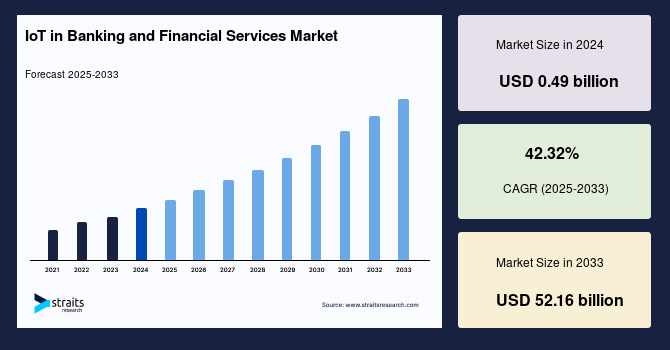
The global IoT in banking and financial services market size was valued at USD 0.49 billion in 2024 and is expected to grow from USD 0.76 billion in 2025 to reach USD 52.16 billion by 2033, growing at a CAGR of 42.32% during the forecast period (2025-2033).
1. Introduction & Market Overview
IoT technologies empower financial institutions to connect sensors, devices, and networks to gather real-time data, automate operations, and enhance customer experiences. In the banking and financial services sector, IoT applications range from smart ATMs, biometric authentication, and connected branches to fraud detection, risk management, and personalized customer engagement. These capabilities support digital transformation agendas, enabling institutions to offer innovative services, improve security, and streamline operations.
Rapid adoption of mobile and online banking, increased deployment of connected infrastructure, and regulatory pressure to combat fraud and optimize operations are key drivers of IoT adoption in this market. IoT also supports insurers through telematics, wearable integrations, and usage-based policies.
For more information : https://straitsresearch.com/report/iot-in-banking-and-financial-services-market
2. Latest Trends in the Market
a. Enhanced Security & Fraud Prevention
Security remains a central focus for IoT adoption in financial services. Devices and sensors generate real-time telemetry that feeds AI-driven fraud detection systems, enabling quicker anomaly detection and reducing false positives.
b. Cloud & Edge Integration
Cloud platforms and edge computing are accelerating IoT deployments by enabling scalable, secure data processing with reduced latency. Banks migrating to cloud architectures can more effectively analyze real-time data streams from connected devices.
c. Customer Experience & Personalization
IoT data helps institutions map customer behavior across channels, improving personalization in banking offers, service delivery, and engagement strategies. For example, smart ATMs, wearables, and mobile integrations enable tailored banking services.
d. Rise of Smart Branches & Connected Infrastructure
Financial institutions are integrating IoT sensors for environmental monitoring, occupancy analytics, and connected security, boosting operational efficiency and reducing downtime. Such investments improve service delivery and branch productivity.
Download Your Sample Report Now : https://straitsresearch.com/report/iot-in-banking-and-financial-services-market/request-sample
3. Challenges & Opportunities
Key Challenges
Security & Data Privacy Concerns: With more endpoints connected to banking networks, the attack surface expands, necessitating stringent encryption, access control, and compliance with regulations like GDPR.
High Implementation Costs: Building or retrofitting infrastructure to support IoT, including sensors, connectivity, and backend analytics, requires substantial investment, especially for smaller institutions.
Integration with Legacy Systems: Many financial institutions still rely on legacy platforms, making seamless integration with IoT technologies structurally complex and resource intensive.
Growth Opportunities
Emerging Market Expansion: Asia-Pacific and Latin America present high growth potential due to increasing digital banking adoption and IoT investments.
Usage-Based Insurance & Telematics: Insurance companies can leverage IoT data from telematics and wearables to tailor premiums and improve risk assessment models.
Real-Time Data Analytics: IoT combined with AI and big data analytics enables better risk modeling, predictive maintenance of ATMs, and targeted customer services.
Bank-Telecom Partnerships: Collaborations between banks and telecom providers to offer IoT-based financial services (e.g., co-branded savings products) are expanding the market footprint.
Buy Now : https://straitsresearch.com/buy-now/iot-in-banking-and-financial-services-market
4. Segment Overview – ABC
A. By Offering / Component
Hardware: Includes sensors, biometric devices, smart ATMs, and IoT gateways. Hardware remains vital in establishing connected infrastructure across branches and devices.
Software & Platforms: Software enables data ingestion, device management, analytics, and integration with core banking systems. This segment is critical for insights and automation.
Services: Managed services, consulting, integration, and maintenance are essential for smooth IoT deployments across complex enterprise environments. Managed services are increasingly driving implementation excellence.
B. By Deployment
On-Premise: On-premise deployment remains common due to concerns over data sovereignty, latency, and regulatory compliance.
Cloud: Cloud deployment is rapidly growing as institutions seek scalability, real-time analytics, and lower operational costs. Cloud integration supports agile rollouts and remote monitoring capabilities.
C. By Application / End-Use
Banks: Banks account for a significant share, using IoT for ATMs, branch automation, security, and personalized banking solutions.
Insurance Companies: Insurers leverage IoT for telematics, usage-based premiums, and health monitoring, driving rapid growth.
Mortgage & Brokerage Firms: These segments use IoT for data capture, asset monitoring, and real-time market analytics to improve processes and client services.
5. Top Players & Recent Developments (2024–2025)
The IoT in Banking and Financial Services space includes a mix of technology giants, platform providers, and consulting firms working to deliver connected solutions:
Microsoft: Strategic partnership with Infosys in 2025 to accelerate IoT solutions using Azure, edge computing, and AI, enhancing digital transformation within BFSI.
IBM: In 2025, IBM secured a multi-year global bank contract to implement Watson AI and cloud-based IoT analytics for branch automation and security.
Oracle: Launched Oracle Banking IoT Edge in 2025 to enable real-time device data streaming from ATMs and branches to cloud systems for fraud detection and operational optimization.
Cisco, Qualcomm & Broadcom: Provide core IoT hardware, connectivity, and edge computing infrastructure for secure and scalable deployments.
Accenture & TCS: Leading services and integration partners enabling end-to-end IoT system implementations.
Notable Initiatives (2024–2025)
Over 50 banks deployed smart ATM systems that improved operational efficiency by roughly 30% across branches.
Key biometric IoT solutions reduced identity verification errors by about 20% in deployments across 45 institutions.
6. Impact of Current World Situation
Digital Acceleration Post-Pandemic
The COVID-19 pandemic accelerated financial services digitalization, pushing institutions to adopt remote services, smart technologies, and IoT solutions to meet customer expectations and maintain continuity. IoT enables remote monitoring of branch infrastructure and more resilient operations.
Cybersecurity & Regulatory Focus
Growing cyber threats have made IoT security a priority. Institutions are investing heavily in encryption, real-time threat detection, and secure device management to protect sensitive data flowing through connected endpoints.
Emerging Markets Push
Regions like Asia-Pacific and Latin America are investing in IoT infrastructure as part of digital banking and fintech growth strategies, fueling market expansion beyond traditional players in North America.
7. Most Asked Trending FAQs
1. What is IoT in banking and financial services?
It refers to connected devices and sensors integrated within financial systems to enable real-time data collection, automation, and enhanced customer services.
2. How big is the IoT in banking and financial services market?
The market is forecast to grow from about USD 61.23 billion in 2025 to nearly USD 108.92 billion by 2030, with continued expansion expected beyond.
3. Which segment leads adoption?
Banks account for the largest share, using IoT for security, smart branches, and customer experience enhancements.
4. What are key trends in IoT for BFSI?
Trends include AI-enhanced security, cloud and edge integration, smart infrastructure, and personalized services via connected devices.
5. What challenges does the market face?
Challenges include security concerns, high implementation costs, and legacy system integration hurdles.
6. Who are major players?
Key companies include Microsoft, IBM, Oracle, Cisco, Qualcomm, Accenture, and TCS, as well as other tech and services partners.
Conclusion
The IoT in Banking and Financial Services Market is entering a high-growth phase as financial institutions invest in connected technologies to improve security, customer experience, and operational efficiency. IoT deployment, supported by cloud and AI integration, enables real-time insights, fraud mitigation, and personalized services across banking and insurance verticals. Although challenges such as cybersecurity and legacy integration persist, strategic partnerships with technology leaders and increasing adoption across emerging markets underscore a bright future for IoT innovations in the financial services landscape. Continued focus on scalable, secure, and customer-centric solutions will drive sustained market growth through 2035 and beyond.

Write a comment ...