
Market Size Overview
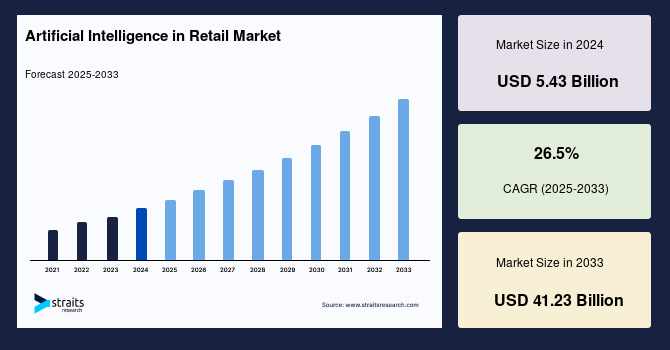
The global artificial intelligence in retail market size was valued at USD 5.43 billion in 2024 and is expected to witness rapid expansion, reaching USD 7.12 billion in 2025. Over the forecast timeline, the market is projected to surge significantly and attain USD 41.23 billion by 2033, registering a strong CAGR of 26.5% during 2025–2033. This exceptional growth highlights the increasing reliance of retailers on AI-powered solutions to enhance operational efficiency, customer engagement, and decision-making.
Get Your Sample Report Here:
https://straitsresearch.com/report/artificial-intelligence-in-retail-market/request-sample
Market Overview
Artificial intelligence in retail refers to the application of machine learning, natural language processing, computer vision, and data analytics to optimize retail operations and improve customer experiences. Retailers are increasingly adopting AI to analyze vast volumes of consumer data, predict demand patterns, personalize recommendations, and automate processes across both online and physical stores.
The growing complexity of omnichannel retailing, combined with rising customer expectations for seamless and personalized shopping experiences, has positioned AI as a strategic necessity rather than an optional technology. Retailers are leveraging AI to gain real-time insights into consumer behavior, optimize inventory levels, and enhance pricing strategies.
Market Drivers
Growing Demand for Personalized Customer Experiences
Modern consumers expect tailored shopping journeys, personalized product recommendations, and targeted promotions. AI enables retailers to analyze customer data and deliver individualized experiences across digital and physical touchpoints, significantly boosting customer satisfaction and loyalty.
Expansion of E-commerce and Omnichannel Retail
The rapid growth of e-commerce and omnichannel retail models has accelerated the adoption of AI-driven tools. AI supports dynamic pricing, intelligent search, visual recognition, and virtual assistants, helping retailers manage complex digital ecosystems efficiently.
Increasing Focus on Operational Efficiency
Retailers are under constant pressure to reduce costs and improve efficiency. AI-powered demand forecasting, inventory optimization, and automated supply chain management help minimize stockouts, reduce overstocking, and enhance overall profitability.
Advancements in Data Analytics and Cloud Technologies
The availability of advanced analytics platforms and scalable cloud infrastructure has lowered barriers to AI adoption. Retailers can now deploy AI solutions more quickly and cost-effectively, driving widespread implementation across the industry.
Market Challenges
High Implementation and Integration Costs
Deploying AI solutions requires significant investment in technology infrastructure, skilled talent, and system integration. Smaller retailers often face challenges in adopting AI due to budget constraints and limited technical expertise.
Data Privacy and Security Concerns
AI in retail relies heavily on consumer data, raising concerns around data privacy, security, and regulatory compliance. Ensuring ethical data usage and adherence to data protection regulations remains a critical challenge.
Complexity of Managing AI Systems
AI models require continuous monitoring, training, and updates to maintain accuracy and relevance. Managing these systems can be complex, particularly for retailers lacking in-house AI expertise.
Market Segmentation Analysis
By Component
The market is segmented into solutions and services. AI solutions include software platforms for analytics, recommendation engines, and computer vision applications. Services encompass consulting, integration, deployment, and maintenance. Solutions account for a major share, while services are gaining momentum as retailers seek expert support for AI implementation.
By Technology
Key technologies include machine learning, natural language processing, computer vision, and deep learning. Machine learning dominates the segment due to its widespread use in demand forecasting, recommendation systems, and customer behavior analysis. Computer vision is increasingly used for cashier-less stores, facial recognition, and shelf monitoring.
By Application
Artificial intelligence is applied across multiple retail functions such as customer relationship management, supply chain and inventory management, pricing and promotion optimization, visual search, and fraud detection. Customer analytics and personalization represent a leading application area, driven by the need to enhance customer engagement.
By Retail Type
The market serves both online and offline retailers. Online retailers extensively use AI for recommendation engines, chatbots, and dynamic pricing, while offline retailers deploy AI for in-store analytics, smart shelves, and automated checkout systems.
Top Players Analysis (As per Straits Research)
Amazon Web Services, Inc.
AWS provides scalable AI and machine learning services that support retail analytics, demand forecasting, and personalization. Its cloud-based AI solutions are widely adopted by global retailers.Microsoft Corporation
Microsoft offers AI-powered retail solutions through its cloud and analytics platforms, enabling retailers to optimize operations, enhance customer engagement, and improve supply chain visibility.IBM Corporation
IBM delivers AI-driven retail solutions focused on data analytics, customer insights, and automation. Its AI platforms support decision-making across merchandising and operations.Google LLC
Google provides advanced AI tools for retail, including visual search, recommendation engines, and customer analytics, helping retailers enhance digital shopping experiences.SAP SE
SAP integrates AI into its retail and supply chain solutions, enabling intelligent inventory management, demand planning, and real-time analytics for large retail enterprises.Intel Corporation
Intel supports AI in retail through hardware and software solutions optimized for edge computing, computer vision, and real-time data processing.
Competitive Landscape and Strategic Developments
Key players in the artificial intelligence in retail market are focusing on product innovation, platform enhancements, and strategic collaborations to strengthen their market position. Investments in AI research, cloud-based solutions, and real-time analytics are shaping competitive differentiation. Retailers are increasingly partnering with technology providers to accelerate AI deployment and achieve faster returns on investment.
Buy Report Now:
https://straitsresearch.com/buy-now/artificial-intelligence-in-retail-market
Download Full Report:
https://straitsresearch.com/report/artificial-intelligence-in-retail-market
Conclusion
The artificial intelligence in retail market is poised for exponential growth, driven by the rising need for personalization, efficiency, and data-driven decision-making. Despite challenges related to cost, data privacy, and system complexity, the benefits of AI adoption far outweigh the limitations. As retail continues to evolve in a digital-first direction, artificial intelligence will play a pivotal role in shaping the future of the global retail industry.
About Us
Straits Research is a market intelligence company providing global business information reports and services. Our exclusive blend of quantitative forecasting and trends analysis provides forward-looking insight for thousands of decision-makers.

Write a comment ...